A Southern Admirer of Nathaniel Hawthorne, Allegedly
Below is a Transcript of a pamphlet published in Salem in 1916. It shows an alleged article by a 'southern admirer' of Nathaniel Hawthorne making a pilgrimmage to his favorite author's hometown and being left rather dissapointed, along with two responses, one from our dear John Robinson Jr. (pg. 23) He has an interesting theory about the whole thing. The original article is from 1839 and by the time of this printing was the subject of much debate, as the foreword explains.
The pamphlet is scarce and this was transcribed off an online library copy from Indiana University by an OCR AI and myself. it is out of copyright as far as I know so here it is.
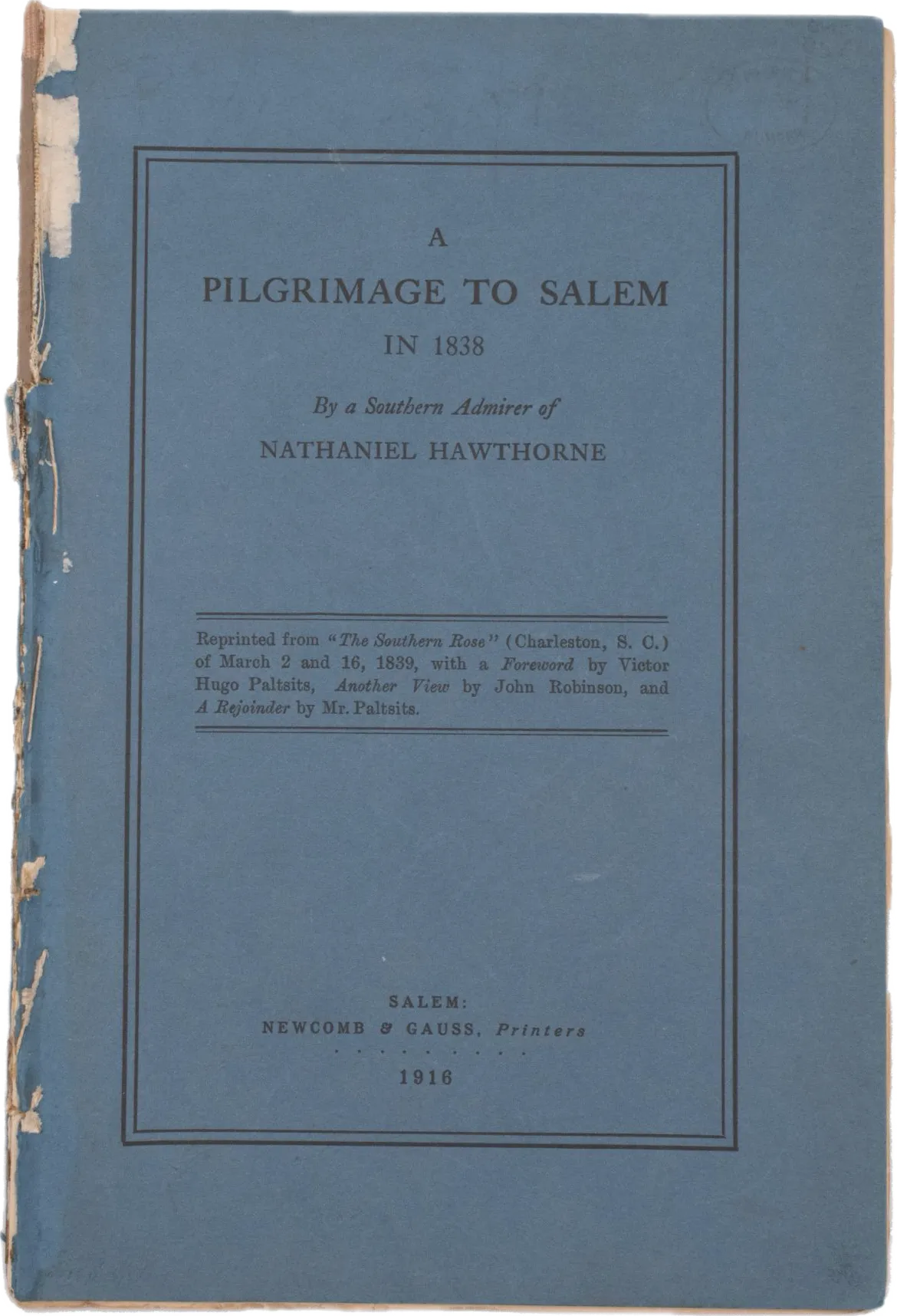
[p. 1 — title page]
A PILGRIMAGE TO SALEM IN 1838
By a Southern Admirer of NATHANIEL HAWTHORNE
Reprinted from "The Southern Rose" (Charleston, S. C.) of March 2 and 16, 1839, with a Foreword by Victor Hugo Paltsits, Another View by John Robinson, and A Rejoinder by Mr. Paltsits.
[perforated library stamp: INDIANA UNIVERSITY LIBRARY]
SALEM: NEWCOMB & GAUSS, Printers 1916
[A small pencil mark under "PILGRIMAGE" on the library copy.]
[p. 2 — limitation page]
The Essex Tracts No. VI. [in blackletter] [stamped accession number:] 320642 [handwritten call number:] PS1884 .P6
ONE HUNDRED AND TWENTY-FIVE COPIES PRINTED FOR GEORGE FRANCIS DOW AND HIS FRIENDS
[perforated library stamp, reversed: INDIANA UNIVERSITY LIBRARY] [handwritten:] Spec. Lib. Fd (English) [stamped:] APR 2 1938 [p. 3]
FOREWORD.
The story here reprinted for the first time recounts a pilgrimage to Salem in search of Nathaniel Hawthorne, by a southern admirer of his "Twice Told Tales". Although it was printed in The Southern Rose of Charleston, S. C., in two instalments, on March 2 and 16, 1839, it seems to have escaped all bibliographers and collectors of Hawthorniana, no doubt because of the unusual rarity of this literary periodical. It was my good fortune some years ago, to purchase fifteen miscellaneous volumes for fifteen cents at one of the sales of the library of the late Bishop John F. Hurst, and one of these volumes contained a file of The Southern Rose, from September 2, 1837, to May 11, 1839. The nugget of the lot was the issue of January 19, 1839, which contains the first edition of Hawthorne's "The Lily's Quest. An Apologue", written "For the Southern Rose", and with his name, "By Nathaniel Hawthorne. (Author of Twice-Told Tales)." In the year of Hawthorne's centenary, I made for the New York Public Library, with the co-operation of the late J. Chester Chamberlain, the first exhibition of Hawthorne showing every known separate first edition of his writings, and prepared a catalogue thereof for the "Bulletin of the New York Public Library." A little later, from December 8-24, 1904, the Grolier Club of New York City, also with Mr. Chamberlain's active assistance, held an interesting exhibition of Hawthorne's first editions, together with some manuscripts, letters and portraits. Among the manuscripts shown was the original of "The Lily's Quest", written on white paper, on both sides of the leaf, folded as sent through the mail by the author to Caroline Gilman, editor of The Southern Rose, and talented wife of Dr. Samuel Gilman, pastor of the Unitarian Church at Charleston, S. C. This original manuscript is owned by William Loring Andrews, the well-known collector and author of hand- [Pencilled vertically in the left margin of the library copy, only partly legible — my best reading, a guess: "Schulte's …". Probably a bookseller's or cataloguer's note (inference).] [p. 4] some books; but the Grolier Club was unable to show the number of the periodical in which the story was first printed, and Mr. Chamberlain, whose Hawthorne first editions excelled any other known collection, informed me that he had never seen the printed story in The Southern Rose. It was this interest in Hawthorne and the acquisition of "The Lily's Quest" that led me to examine carefully the other numbers of Mrs. Gilman's periodical, which was rewarded by the discovery of the article on the Salem pilgrimage. It now became a matter of speculation as to who was the author of the Salem pilgrimage. I am of the opinion that the writer was William Gilmore Simms. He made his first visit to New England in 1832, at Hingham, Mass., and during the decade several of his books were published in Boston or New York. The anonymous writer mentions a widow who was "two or three years older" than he, and who had a daughter "just on the verge of sixteen." As Simms was about thirty-two years of age in 1838, the circumstance could fit him. Moreover, the writer refers to his "Southern plantation", and Simms had been spending his autumn and winter months since 1836 on a plantation called "Woodlands", half way between Charleston and Augusta, S. C., the property of his second wife's father, Nash Roach; whilst during the warmer seasons Simms resided at Charleston or visited the North. He was also one of Mrs. Gilman's contributors. It is true that the article contains local allusions that an ordinary stranger could not be expected to pick up; but Simms was not an ordinary man and was not a perfect stranger in New England. A man of his known talents for observation and appreciation of a local literary setting could have no difficulty in taking note of the allusions which are found in the quest for the elusive Hawthorne.
VICTOR HUGO PALTSITS.
New York City, November 20, 1916.
[p. 5]
For The Southern Rose.
A DAY OF DISAPPOINTMENT IN SALEM.
BY AN ADMIRER OF "TWICE-TOLD TALES."
I had completed my Northern summer tour, and was lingering through a few days at the Tremont House, in Boston, for the arrival of a party of friends from Canada, in order that we might all start together on the journey to our southern homes. To beguile the tedious and vacant hours of my delay, I had resorted to the various expedients which suggest themselves to a solitary stranger. I had made numerous excursions on foot to the enchanting environs of the American Athens. I had paid a sweet and solemn pilgrimage of several hours to Mount Auburn. I had gone up to the dome of the State House on two different sun-shiny afternoons, and drank a full flow of delight (no less intense for arising from a twice-told tale) from the wonderful landscape around,—more gorgeous and varied than an Achilles' shield,—those distant, slumbering, yet shining towns—those hundred steeples scattered, like the religion they represent, in all quarters of the horizon—those graduated hills far off at the south, along which I could not help fancying that Neptune sometimes ascended, as up a flight of stairs, when, tired of the storms and calms of his own ocean, he was desirous of refreshing himself with a glimpse of the works of the demigod man—that beautiful harbor with its small green islands—the winding, glistening Charles, with its bridges, and bays, and causeways—the venerable group of edifices at Cambridge, glowing amidst the picture, as if Learning and Religion had said to each other, sit we down here together and form a part of the bright glories of this mysterious emblem-world,—that vast city at my feet, with its palaces, halls, camera-obscura squares, winding streets, autumn-brown gardens, mirrored roofs and towers, leafless [p. 6] forests of dim-receding masts, and hazy-blue atmosphere, penetrating, overspreading, and harmonizing all; itself also harmonizing exquisitely with the gently lessening sounds of a busy population as the shades of twilight deepened—and last, in still nearer perspective, beneath my downcast eye, that extensive common, crossed by numerous footpaths, in which I could discern now and then a couple of saunterers of different sexes, but too minute by reason of distance for me to distinguish whether they were lovers mutually dreaming away a too short happy hour, or a little brother and sister returning leisurely home from their contented school. I had several times strayed to the Atheneum (impressive exponent of united intellect, refinement, and munificence!)—had wandered and paused through its encyclopædic range of apartments—had skimmed the world's periodical literature on the tables of its reading-room, and amidst the favoring silence of the visitors had beheld, with a feeling of almost terrific enchantment, the cast of "Laocoon's torture dignifying pain— "A father's love and mortal's agony "With an immortal's patience blending; vain "The struggle; vain against the coiling strain "And gripe, and deepening of the dragon's grasp, "The old man's clench; the long envenom'd chain "Rivets the living links; the enormous asp "Enforces pang on pang, and stifles gasp on gasp." [The verse is Byron, Childe Harold's Pilgrimage, canto IV, st. 160 — my identification; the article does not name it.] The shops of the booksellers, also, presented their resistless attractions in my daily walks. What delicious lounges! How invariably polite and kind, both masters and clerks! How willing that I should gratuitously entertain myself for hours amidst their "treasures new and old" and how especially welcome was I made to the full enjoyment of their luxuries, when it was perceived that I was rather a liberal purchaser of their choicest publications! A chair in the quietest corner of the shop, yet not too remote for a gentle and unoffending glance at the fair customers who applied almost every moment in the day for pocket-books, gold pencils, annuals, tablets, and [p. 7] the last new novel, was always secured for the gentleman who, on a single day, could select and order to his lodgings a parcel containing Prescott's Ferdinand and Isabella, Bancroft's United States, Sparks' Franklin and Morris, Everett's and Story's Miscellaneous Writings, Miriam, The Works of Thomas Carlyle, Furness on the Gospels, and other novelties of like commanding interest. One morning, while ruminating somewhat vacantly in my privileged nook in one of these favorite haunts, the graceful and obliging shop-boy brought me a volume, which he said he should have certainly offered me before, had he not believed that every copy had long since been disposed of. This, however, had by some accident been concealed beneath a large pile of the Retrospect of Western Travel. He was sure I should be pleased with it, and begged me to give it a cursory inspection. The title of the book, "Twice-Told Tales, by Nathaniel Hawthorne," put me at once upon a train of musing speculation. I knew not whether to consider it attractive or repulsive. Generally speaking, a twice-told tale is a tedious affair. Some tales, however, will very well bear repetition, and who knows, thought I, but such may be the case with those before me? Twice-told tales, moreover, are often fresh and new to some portion of the audience; and as I learned from my active little Mercury that this compilation of narratives and fancies acquired their existing title from having nearly all appeared previously in various periodicals, I acknowledged that they at least must possess the charm of novelty for those who, like me, could indulge but sparingly in that sort of reading. Thus, the reasoning of a moment or two (would that all prejudices might be as easily surmounted!) dispelled the unworthy prepossessions I had been induced to entertain. On the other hand, a little further reflection awakened me to a sense of the peculiar beauties and merits of this singular title. Like all new converts, I was now inspired with an inborn zeal for what I had just before repudiated. Twice-Told Tales! How simple, how antique, how purely Saxon [p. 8] these three little alliterative words! How they transport us at once to the enchantments of the middle ages and of minstrel utterances. Then again, what a frank and sturdy honesty there is about them! The author of the book seems to say, "I give the world fair warning that these tales have been published before. It is possible you may have dined on the same fare yesterday. If, gentlemen, you can tolerate a picked-up dinner, here are the fragments of former entertainments, collected and served to the best of my ability. So, walk in! But if you can put up with nothing short of a fresh-killed and entire turkey, and a new batch of pies and puddings directly from the oven, you must go your ways and be entertained elsewhere." I perceived also in the same circumstance a noble self-reliance—a modest confidence that the book had merits and would win its way, notwithstanding the unpretending and even self-disparaging character of the title. Thus inspired with favorable inclinations, I opened the volume, and glanced rapidly over the two first articles. The result of this hasty inspection was, that I threw a half eagle on the counter, waited impatiently for the change, and hurried home to my lodgings with the book, which, before I slept on my pillow that night, deserved, at least from my experience, the title of "Thrice read Tales." On the next day, my mind was full of Nathaniel Hawthorne. I felt rejoiced that a first-rate book was added to our scanty American library—a first-rate classic to our incipient literary galaxy. I hailed the appearance of another genuine original on this threadbare earth: and better still, I hailed the appearance of one of the rarest productions of human nature—an original, devoid of almost every exceptionable or offensive quality. For alas, thought I, originality is too often attended with some enormous evil genius—some outrageous affectation—some perilous error—some frightful absurdity in taste, opinion, or morals. Not so with Nathaniel Hawthorne. He is as good, as delicate, as pure, as old-fashioned, as sensible, and as safe, in all his sentiments and conceptions, as the [p. 9] most timid worshipper of established proprieties could desire. One of the greatest triumphs, indeed, of his genius, is to have mingled so much bold, broad humor, so much keen, flashing wit, with a taste so exquisitely fastidious and refined. Nor does it detract from his originality, that he occasionally reminds us of the quaintness of Lamb, or of the almost feminine lusciousness of Washington Irving's picked and perfect English. These things are merely extraneous and accidental—just as if Shakespeare should have made a bow like Sir Philip Sidney, or Lord Byron unconsciously imitated the tone of his friend Rogers. Enough is left behind to constitute him one of the most original of American writers. A single paper of his, "Rills from the Town Pump," for instance, is enough to give any man a lasting reputation. It is one of those unique and fortunate productions that genius sometimes throws off to excite wonder and delight, and to defy imitation,—such as Horace's Visit to Brundusium, Boileau's Third Satire, Pope's Rape of the Lock, and Irving's Rip Van Winkle. Oh that respectable, sensible; humorous town-pump! Who would have supposed it possible to elevate a pump to all the dignity and interest of a living personage? Who can read the paper, without feeling a loving sympathy for that worthy, eloquent, and slily satirical piece of wrought timber, shall I say? or may I rather call it that fragment of oaken humanity? Surely, the inhabitants of Salem, where Hawthorne resides, if they rightly appreciate such an author, would be willing to appoint him their essayist-laureate, with a handsome salary. They would settle him as a parish settles a minister, with the understanding that he should furnish something periodically for the gratification and instruction of the town. I should like, some time or other, as a mere jeu-d'esprit, to try my hand at imitating him. Yet how impossible to catch his felicities! How difficult to strike like him first into an unbeaten track of imagination, and then to strew it with characteristic flowers of wit, fancy, fact, humor, eloquence, and wisdom, as I went along! [The semicolon in "sensible; humorous" is as it appears in the scan.] [p. 10] Thus I ran on in my reflections at different times and places through the day, admiring the depth and happiness of my own criticisms almost equally with the qualities of my new favorite,—till at length, I wrought myself up to such a pitch of enthusiasm, that I resolved on the morrow to visit Salem, and obtain, if possible, before I left New England, a sight of the author of Twice-Told Tales. Accordingly, I found myself at the appointed hour among the crowd on board of the steamboat, which was to transport us over the ferry to the commencement of the new Rail Road between Boston and Salem. Just before starting, an acquaintance introduced me to two ladies, whom he placed under my charge for the journey, as it was out of his power to accompany them himself. "Take care of your heart," said he in a whisper, as he led me aside for a moment. "Between that lovely widow and her daughter, there is but a slender chance of your getting back to Boston entirely unscathed, and the result may be, either that one of them will attend you next fall to grace your Southern plantation, or that you will be induced to transfer your interests to New England, and form a connexion and residence among the Yankees. Yet in either case, I shall congratulate rather than pity you, for they have every sort of recommendation one can imagine or desire." A caution so abrupt and pointed had, I confess, a singular effect upon my mind. Instead of fortifying me against the charms to which I was to be exposed, it only rendered me more vulnerable to their power. There are certain cases, in which, if you inform a man of his danger, you do but increase the risks of his losing himself. A calm and unconscious feeling of security is sometimes a better guide through perils than the exciting terrors of admonition. Cruel and almost insulting inconsistency! To awaken one's anxiety and interest respecting one's companions for a pleasure-jaunt, at the very moment that you warn him to beware of losing his heart! So I shall not dwell upon my emotions as I rejoined the two ladies, by [p. 11] whose side I remained until I conducted them to the door of their friend in Salem. They were both very beautiful. The widow was two or three years older than myself, while her daughter was just on the verge of sixteen. Their conversation was animated, intellectual, and spiritual; bearing marks of the highest female cultivation for which their city is renowned; yet modified considerably by the age and character of each party. The daughter was full of enthusiasm—imbued with the transcendental philosophy just springing up, inclined to doubt the utility of all forms; familiar with Wordsworth and Carlyle, and bent upon a certain philanthropic project of establishing schools for adults, of which the teachers should be children, as being nearer the Source and Centre of all spiritual Light. In short, what with her loveliness and extravagance, I could not avoid perpetually regarding her as a sort of delightful dream.—Her mother, with equal, though different attractions, I may call, not a dream, but a waking vision. She, too, had her high hopes and aspirations, her large, kindling views, her enthusiastic schemes of improvement; but amidst them all, she seemed to have solid ground to tread upon. She reverenced, though she did not worship the spirit of the Past. She believed there was a desirable medium between slavish routine and vague extravagance. She quoted the Edinburgh Review; and once, I remember, when a little excited by her daughter's inveighing against all forms, she with some warmth expressed her hope that the young ladies of the present day would not take it into their heads to get married after the manner of the turtle doves. Take the two ladies together, however, they were a truly fascinating pair. The very points of contrast in their characters and sentiments did but inspire me with a more vivid interest. The suggestion of my friend, as to one of them accompanying me to the South, irresistibly intruded itself on my mind. On him be all the burden of so presumptuous an idea. Of myself, I should not probably have [p. 12] ventured to entertain and cherish it. But the spark had caught. My imagination was kindled. And to my surprise, I found myself silently inquiring, "Which of them will go?" On bidding them farewell, their cordial smiles, their expressions of gratitude for my attentions, and their frank solicitations for my protection on our expected return the next morning, absolutely banished from my mind for a few moments the object of my visit to Salem. I wandered at random a short time through one of the streets of that beautiful city, without inquiring for the residence of Nathaniel Hawthorne, but as I mused and strayed along, I involuntarily revolved the questions—"Which of them will go? Will either of them go? Would not both be pleased with a residence at the South? Shall I take the enchanting dream? or shall I invite the more solid waking vision?" But the surrounding novelties of a strange city now dispelled these pleasant reveries, and recalled me to my original purpose. I discovered the way to the lodgings of my favorite author. He was not within, but would probably be at home some time in the course of the day. I inquired respecting his haunts. They were the Athenæum—the bookstores—the streets occasionally, or North Fields, or South Fields, or the heights above the turnpike, or the beach near the fort; and sometimes, I was told, he would extend his excursions on foot as far as Manchester, along the wave-washed, secluded, and rocky shore in Beverly. It was out of the question for me to explore all these places, as I could not prudently spare more than a day on my present adventure. I resolved, however, to do what man and my limited time could do for the accomplishment of my design. I first visited every bookseller's shop in town, and inquired with an air of assumed indifference if Mr. H. had been there that morning. He had, I was told, lounged a few moments at one of them, and taken away the last number of the Democratic Review. But in none [p. 13] of these resorts was he at present to be found. I next inquired my way to the Athenæum, or public library of the city. On my asking a gentleman if the person I was seeking were present, he replied, "It is scarcely a quarter of an hour, Sir, since Mr. H. was mounting that ladder, to return to its shelf a book he has had out some time, on the early history of New England. If you are very anxious to see him, he may possibly be found on the Neck below the town, where he sometimes walks on so fine a morning as this." So down to the Neck I hastened, and although I was still unfortunate in my search, since I saw no human being along those solitary fields and shores, yet I was half repaid for my trouble and disappointment by the distant views of Beverly on the one side, and of Marblehead on the other, and the larger and nearer city in my rear, while in front the harbor exhibited its islands and the rolling and glistening of its fresh waves. I returned and dined at a hotel; after which, I made another attempt to surprise my quarry at his lodgings, but in vain. He had not been seen since the morning, and in fact was sometimes known to pass a whole day abroad, without communicating his intentions to the household. Still undiscouraged in my pursuit, I inquired the location of some of the most retired, romantic, and beautiful scenes in the vicinity of Salem. When Orne's Point was described, I determined to direct my course thither, thinking it possible I might there discover the interesting object of my pursuit. Passing up Essex-street, in the stillness of the early afternoon, when scarcely a citizen was yet returning from dinner to his place of business, I came to its intersection with Washington-street, where I immediately recognized my old friend the Town Pump; just as Andrew Jackson or Queen Victoria would be recognized by one who had for some time been in possession of a faithful, living, striking portrait of either of those eminent personages. I could not pass the spot without stopping, for I felt as if on classic soil. All was silent and [p. 14] solitary around. The beams of the autumn sun came down upon the dry, warm iron basin affixed to the pump's venerable nose. I quaffed a generous draught of the cool beverage, partly for my own bodily gratification, partly as a token of respect to my inanimate friend, and partly in honor of the felicitous reporter of his speeches. I then said within myself, "I will wait here a while, for I may be amused by some of the visitors who have already amused me in description before;—and who knows but the very man I am in search of may, on his return home to a late and solitary meal, pass this way, and observing a well-dressed, bookish-looking stranger gazing with fervent admiration on his own glorified pump, may betray by a conscious smile his authorship and identity?["] So there I stood for half an hour, but of the forty or fifty persons who passed during that time, though many stared at me with some astonishment, yet none appeared to exhibit the slightest sympathy with my situation, nor should I have judged from their physiognomy or carriage, that any one of them was at all capable of composing a book like the Twice-Told Tales. As for the pump itself, it remained all the while untroubled, save by one fair little girl who filled her pitcher from it, and then retired, gazing with a fond but pardonable vanity into the liquid mirror in her hands,—the very child, I have no doubt, who was immortalized for the self-same act in the original "Rill from the Town-Pump." [The bracketed ["] after "identity?" is printed in the 1916 text — the 1916 editor's supplied closing quote, not mine.] I reached Orne's Point by the middle of the afternoon. It is one of the loveliest retreats imaginable, and lies at the distance of a short two miles from the centre of Salem. A hill covered with trees overhangs a small and beautiful secluded bay. A mile or more down this bay where it widens towards the sea, one of the longest bridges in the state connects Salem with Beverly. On a calm day, as you stand upon the rocks at Orne's Point, you will hear the frequent tramp of horses and carriages traversing the bridge, and you will scarcely be able to conceive how so loud and rapid and near a noise could proceed from the [p. 15] little black spot which your eye discerns moving like a slowly creeping insect over the distant bridge. I paused for a full half hour enjoying in solitude the perfect beauty of this delightful scene. Its picturesqueness was not a little heightened by the appearance of two cranes stalking silently in the shallow water, and at length simultaneously rising and soaring slowly away over the trees. Their departure was the signal for my own. After idly skipping a few stones over the smooth surface, and looking round in vain through the trees and on a neighboring cliff for my desired companion, I retreated lingeringly towards the main road. Farewell, unrivalled spot! said I almost aloud. Worthy art thou of the tasteful and observing visits of a being like N. H., and next to the pleasure of seeing himself, I at least feel indebted to him for indirectly and unintentionally giving me this glimpse of thee! Falling into company with a teamster on the Danvers road, who gave me a very interesting account of a Lyceum which he subscribed for and attended, I was shown by him the hill on which were executed the Salem witches of old. Listless and disappointed, I rambled thither, and felt my mind somewhat excited by the reminiscences incident to the spot. I then pursued my way westwardly across many fields and hills and hollows towards a populous looking settlement, and found myself in an ancient and extensive graveyard. I examined a few of the inscriptions, of which one happened to be the epitaph of poor Eliza Wharton, whose sad history I had read and wept over when a youth. What an eventful and fruitful walk, thought I, would this be for Hawthorne himself! How would trains of historical incidents, and heart-touching reflections be awakened in his mind, to constitute, perhaps, a choice portion of the second volume of Twice Told Tales! [A reader has pencil-underlined "of poor" in the library copy.] The westering sun reminded me that I must rapidly direct my course to the city. On arriving at the corner, where the turnpike leads off to Boston, I remembered that the heights above it had been mentioned as one of the resorts of my favorite author. There was still enough of [p. 16] sunlight left to encourage me in exploring this spot also; while the prospect, which I should at all events enjoy, presented a strong temptation to the enterprise. I clambered up the rocky precipice, and as I turned round to view the city, the setting luminary threw a strong golden glare on all its steeples and windows and waters, together with the populous villages that spread far out towards the northern horizon. I stood entranced with this new vision. Less magnificent and imposing than the view from the Boston State House, it exhibited a repose, a oneness, a gem-like completion, which the other does not possess. The noise of Boston was wanting, scarcely a sound being heard except the striking of the "north clock," which was immediately and faintly echoed by the striking of the more distant "east." I permitted the prospect to fade away before my eyes, one tinge dying out after another—one object or group hiding quietly behind a nearer—till [t]he sombre curtain of a gathering twilight left me just glimpses enough to commence finding my way back to town. On turning to look for an eligible path down the precipice, I observed a gentleman standing at some distance from me, eyeing the same scene with an interest as deep as mine, and lingering longer than myself, as if more unwilling to depart, or better acquainted than I was with the method of descending from the height. I immediately approached him, delighted with the belief that I had not undertaken my somewhat romantic pilgrimage in vain[.] We exchanged a few words on the exceeding beauty of the prospect we had just been surveying. The stranger was accessible and companionable. I told him I was from a distant part of the United States, but was not ignorant of the reputation sustained by Salem in reference to the past progress and present elevation of the country. "With no common emotion," said I, as we descended the cliff and entered the outskirts of the city, "have I trodden the streets and gazed on the scenes where a BOWDITCH passed so many years of his life—and a HOLYOKE calmly turned [Two printing slips on this page: "he sombre" (the t has dropped) and no full stop after "in vain". Both supplied in brackets.] [p. 17] his hundredth year—and the venerable and gentlemanly PRINCE pursued his scientific improvements to so late a period—where a jurist and a philologist, who are still living and have done so much for their favorite sciences and for their country's reputation, long resided,—and may I not add, without flattery, where so many admirable effusions have perhaps proceeded from him whom I now have the honour to address?" The gentleman smiled and bowed as if pardoning the compliment, observing, it was true he had written a few things that had been favorably received by the public, but that he was far from arrogating the distinction I had assigned to him. "However," continued he, as we passed along through Chestnut Street, whose beautiful avenue of trees and elegant residences on each side, were now illumined by the rising moon, "I have often, like yourself, been impressed by the constellation of eminent minds that have shone in our little town since the commencement of the present century. The list you have enumerated, might easily be enlarged. You may not have heard of the learning of our BENTLEY—nor the masterly and comprehensive, but subdued spirit of our WORCESTER, who lies in his grave among the Missionary Stations on the Misssissippi [sic]—nor of several of our learned, cultivated, and sui generis physicians—nor of some of our "merchant princes," whose sagacity, enterprise, and good generalship, established our connections with India, and introduced a flood of wealth and prosperity into the land. I have sometimes entertained the design, as topics connected with this city are always favorite ones with me, of composing a volume which might be entitled, "The Worthies of Salem in the first Quarter of the Nineteenth Century." Such a volume, if properly executed, would, I believe, be very acceptable in this vicinity, as well as to the public at large, and throw a desirable light on the intellectual progress of our country. But as the task could not perhaps be delicately performed during the lives of some of our subjects, an approximation to its completion might be effected by compiling memorials for a future opportunity." [p. 18] "And by whom," exclaimed I, as we arrived and stopped at the door of my lodgings, "could the task be so well executed as by yourself, Mr. Hawthorne?" "Mr. Hawthorne!" replied my companion, with much astonishment. "I have not the honor, Sir, of bearing that name." Then, with a good-natured smile and a pleasant voice, he abruptly bade me good night and departed hastily down the street. Petrified wilh [sic] disappointment and surprise, I had not the presence of mind to go after him, to apologise for my mistake, and learn his real name. After standing some time on the steps, I slowly turned and walked into the house, where the creature-comforts of a generous tea-table afforded me some refreshment from my fatigue, and some diversion to my mortification. When half of the evening had passed away, and I had paid a proper attention to my toilet, I visited with some eagerness my two fascinating companions of the morning car. Having briefly related to them my adventures and chagrins, and provoked a due admixture of their pity and their smiles, I was invited by the lady of the house to accompany them all to a large party in the city, which they were on the point of attending, and where she assured me I might confidently expect an interview with the object of my search. I need not say with what alacrity I accepted the invitation, and made a fourth in the precious-freighted carriage, which bore us rapidly off to the brilliantly lighted and more brilliantly crowded mansion in the vicinity of the Mall. [A short pencil stroke in the left margin of the library copy, beside "their smiles, I was invited".] After presenting me to the hostess of the evening, my fair and kind introducer proceeded to acquaint her with the object I had at heart, and to inquire in what room or corner we might find the gentleman in question. "Sad enough!" said the hostess—"Mr. H. left us a half hour ago, having just made his appearance, and told us that he must return home to his bed, since he was completely worn out with one of the longest day's walks he had ever taken." [p. 19] For the remainder of the evening, as my name was unknown to the generality of the company, I believe I must have been distinguished by them as the gentleman with the long face. I was silent and abstracted, with the exception of a half hour's secluded and agreeable conversation with my accomplished companion of the cliff. Gleams of precious consolation, however, were occasionally afforded me by glances and smiles from the widow and her daughter, as they floated down the whirlpool of attentions, which usually absorb creatures like themselves in a fashionable party. As destiny itself appeared to be against me, I resolved to brave it no more, and to resign the hope of seeing a person who seemed to escape me like the foot of the rainbow. On the next morning, leaving him to his probable repose after his fatigues of yesterday, I punctually executed my appointment with the ladies, and placed myself between them on the back seat of one of the crowded cars. As we waited a few minutes before starting, a gentleman sitting on the front seat held a conversation with a friend who had accompanied him to the car, and who was pausing outside until the departure of the train, but whose person I was prevented by my position from seeing. He seemed animated and inspired by the presence of his friend, and conversed in the tone and manner of one who is desirous of expressing sentiments agreeable to the person he is addressing. I subjoin the substance of his remarks. "I heard last evening," said he, "that after you had gone to Boston yesterday in the car, you came home on foot along the old road through Malden and Danvers. I heartily sympathise with you for so doing. For although the Rail Road is sometimes a convenient evil, yet this condensing of time within a nutshell, and filling up the whole of life with nothing but urgent business, will make sad work, I am afraid, with the best parts of our character. The turnpike was bad enough in this respect, whirling us off to Boston, as it did, in an hour and a half, and whirling us back again on the same day, as if in mockery of the good old leisurely practice of the last generation. [p. 20] Give me the blessed times when a journey to Boston occasioned a week's thought and preparation, and occupied a long summer's day in the performance. That circuitous ride round through Danvers, Lynnfield, and Malden, exerted a blessed effect on our merchants and citizens. It gave them a breathing-spell from care and toil. It afforded them refreshing glimpses of the beauties of nature. It was a kind of week-day Sabbath for the weary soul. Many a match too was made in that way by our young grandfathers and grandmothers. I declare I think I shall in future, as often as once a month, hire a horse and gig and go to Boston on that route, just to keep up the memory of the days gone by. If the hotel at Lynnfield was only still open, where I could stop two hours and take an old-fashioned dinner at my leisure, the charm would be complete. Nothing makes men so worldly-minded as the calculation of the business-value of every instant as it passes. When I can afford to let the minutes roll unconsciously away, I seem to escape from the slavish, mechanical, monotonous tyranny of time, and to partake beforehand of the glorious absolute liberty of Eternity. Soon after the rail-road opened, I went to Boston in the car, because that hubbub Everybody said that I must. The finest thing I perceived about the Road was that it had rescued from the marsh and the salt spray some patches of land, which, they say, produced last summer beautiful flowers. But I found that it had entirely banished from the earth those far lovelier flowers, Patience and Resignation. An accidental detention of four or five minutes threw almost the whole two hundred passengers into a fever of complaint and agitation. You would have supposed that the country was on the verge of ruin, and the Union about to be dissolved, simply because our precious and almighty selves would arrive at Boston at five minutes past nine o'clock, instead of precisely at nine. Surely the old method of travelling was more favorable to the cultivation of Christian virtue. If you had not a long day of pleasure before you, you had one at least of Resignation, and you did not look for the sky to fall, if you happened to be ten [p. 21] minutes or even an hour behind your time. Ah, Sir, you must have seen yesterday what we lose by abandoning that excellent route. Now, there is a gentle rise—then a gentle descent—then a smooth level. Here ther oad [sic, for "the road"] winds round a half mile to take you by a pretty though antique dwelling, or to avoid a lofty hill—and there it proceeds a short distance with a straitness that gives you the pleasure of contrast and surprise; and then again it abruptly turns a corner, where a quince-tree is growing over the fence, and presents you below its branches with a new prospect. All is charming variety. Don't you remember the willow-thickets—and the precipices in Lynn on the left hand of the road—and the frequent and beautiful glimpses of the sea away off to the right? And then when you have endured just fatigue and absence enough to prepare you for the change, how great is the pleasure of approaching and entering the town! But what pleasure of this kind does the rail-road give us? There is no anticipation about it, no gentle transition, no blending, interchange, and succession of feelings, but the only sensation attending it, is that of a hard, uniform, concentrated, iron-beaten Now. I only wish that circumstances this very day permitted me to practice what I preach. But I am whirled along with the multitude and the age,and the locomotive's bell has just done ringing for the last time. So good morning, Hawthorne." "Hawthorne? Hawthorne?" said I, as I jumped suddenly from my seat to the window of the car, where, on looking out, I caught a dim glimpse of a person who had just turned to make his way into the town. At that instant, the train started, and threw me back into my place. One of my feet came with almost a crushing violence on the foot of the younger of the two ladies, who involuntarily uttered a shriek. My confusion and disappointment prevented me from tendering her the apology which was her due. I sat in a moody and sullen silence for the remainder of the trip. The ladies in vain tried to rally me into good humor. The younger condescended even so far as to beg my pardon for what she called her uncivil shriek. Kind and generous spirit! It was I who ought to have [p. 22] volunteered concession. My foot had no business even with the gentlest pressure against hers—much less with a momentum that resembled the hard tread of a horse. But there was a point of forbearance and politeness beyond which their feminine dignity would not permit them to go. They became retired and reserved in their turn, or rather, they opened a most spirited conversation with the friend of Hawthorne; and when we alighted from the carriage that conveyed us from the ferry to their mansion in Summer-street, I received a civil farewell, but nothing like an invitation to walk within, or to visit them in future. My chagrin was somewhat softened by finding that the expected party from Canada had arrived at the Tremont House. We set out the next day on our journey South. New York, Philadelphia, Baltimore, Washington, Richmond, and Wilmington, delayed us each a day or two as we advanced. My Boston disappointments faded from my memory, as an ascending balloon fades from the eye, or as one of the well-known "dissolving scenes" lessens and disappears before the spectator. This result may have been hastened by the presence of a fair member of our party, a native of the South, who was placed under my immediate protection, and in whom I found myself cherishing an increasing interest, as we visited the museums, and curiosities, and various places of relaxation on our route, or were exposed to the usual calms and incidents of a journey. By the time we had arrived in Charleston, I was very nearly induced to make to her the proposition, of becoming an ornament to my plantation—a proposition which I have reason to believe she would have graciously entertained. But some evil genius or other provoked me from time to time to delay the proposal, until a bolder and more fortunate hand conducted her to a sphere which was worthy of her graces and her virtues. This very incident, however, together with my New England experiences as above-narrated, well exemplifies my usual destiny, which never allows me to look perfect satisfaction directly and permanently in the face, but only, like Moses in the wilderness, to behold its DEPARTING SKIRTS.
[p. 23 — ANOTHER VIEW]
ANOTHER VIEW.
After a quite careful study of the question of authorship, it would seem that "A Day of Disappointment in Salem", printed in "The Southern Rose" of March 2, 1839, should not be read as the actual account of a day and night spent in Salem by a stranger, but rather as the gathering together of all possible things imagination could suggest that might happen in the sort of search described, but which could not possibly have happened in reality in that short space. No stranger, however observant or gifted with retentive memory, could acquire even in many visits the familiarity with local place-names, local characters, local terms, shown by the writer of the article; indeed, very few Salemites could themselves have boasted of such familiarity. There are at least forty such references, nor are they mere references, they possess much local color as well. The article must have been written just before publication, probably late in 1838 or early in 1839, Hawthorne's "The Lily's Quest" was printed in the "Southern Rose" in January, 1839. The first volume of "Twice Told Tales" was published in 1837. Hawthorne was wandering in western Massachusetts from July 27 to September 24, 1838. October 24 he was at the Tremont House in Boston noting scenes from his window which later appeared in the "Blithedale Romance". He was in Maine during July and August, 1837, so that with these exceptions and other short visits to Boston and elsewhere, he was at this period living in the Herbert street house in Salem. In carefully reading the article, one is irresistibly led to feel that it must have been written by Hawthorne himself, or by some one close to him, or from copious data [p. 24] furnished by one or the other. It seems impossible that Hawthorne could have written about himself and his own work in the fulsome language of the article. It was not like Hawthorne to do so even anonymously, although here and there his notes and letters suggest that he had some inkling of fame to come and was willing to put such thoughts in writing. At this time Hawthorne had renewed his intimacy with the family of Dr. Peabody and was courting Sophia, whose sister Elizabeth was a writer and later the editor and publisher of "Aesthetic Papers"; both have left letters filled with admiration of Hawthorne, with references to his beauty of feature and character. Mrs. Peabody, the mother, taught a private school in Salem. The family were advanced thinkers. The writer's introduction of a mother and daughter, with their high talk and transcendental predilections, and the whimsical proposal of a school for adults conducted by children, in a way suggest the Peabodys as types. To accept literally the situation of the writer's engaging himself to one or the other,—the young girl or her young mother,—Hawthorne's age certainly would have made him eligible. It is a curious coincidence that the cast of the Laocoön group referred to in the article as seen in the Boston Athenæum, was also to be seen in the museum in Salem, about the only cast of a piece of classical sculpture in the town. The stanza quoted is from Byron, "Childe Harold's Pilgrimage", Canto IV, stanza CLX. Hawthorne rarely quotes poetry in his writings, although referring to poetical works. The exception is in "Fanshawe" where he prefixes a quotation to each chapter and introduces poetry in the text. But, as if in his efforts to obliterate this early, immature work, among other things he appears to have discarded the use of such quotations. Yet Hawthorne seems to have been greatly impressed by the Laocoön, for twenty years later in Rome he expresses his feelings regarding it; he had seen the original in the Vatican: "I felt the Laocoön very powerfully, though very quietly, [p. 25] an immortal agony, witn [sic] a strange calmness diffused through it, so that it resembles a vast rage of the sea, calm on account of its immensity, or the tumult of Niagara, which does not seem to be a tumult because it keeps pouring on forever and ever". In the same volume of notes Hawthorne records his admiration of Byron, even mentioning his treatment of classic scenes and statues:— "Byron has written some very fine stanzas on the battlefield, not so good as others he has written on classic scenes and subjects, . . . whenever he has to deal with a statue, a man, a battlefield, he pounces upon the topic like a vulture and tears out its heart in a twinkling, so that there is nothing more to be said". The reference to the "Democratic Review" is particularly apt, as well as to a book on "early New England history", for Hawthorne was a contributor to the one and a student of the other, and only intimate knowledge of him could have led to these references. And it must be kept in mind that in 1838 Hawthorne had little outside reputation; the "Scarlet Letter", which made him known to the world, was not written until more than ten years later. The places referred to as visited by the writer, in Boston as well as in Salem, associate themselves with Hawthorne, although this may, of course, be purely accit dental [sic, for "accidental"]. Hawthorne stayed at the Tremont House, he was a frequenter of the Boston Athenaeum, and the description of the sights from the dome of the State House, especially the two lovers walking in the Common, who might after all be brother and sister, are very suggestive of Hawthorne or a personal familiarity with his ways and style. Hawthorne liked to write about scenes from high places,—steeples, hills,—and as he had just returned from his Berkshire trip in the fall of 1838, the landscape at the time must have had the "autumnal brown" coloring referred to by the writer of the article as seen from the dome of the State House. And we have seen above that [p. 26] Hawthorne was at the Tremont House, October 24, 1838, making notes used in a later work. The "A Rill from the Town Pump", so much quoted and imitated in the article, was Hawthorne's favorite essay, often referred to by him in after life. The writer of the article highly praises the "Rill" and uses the words "quaffed a generous draught", "east" and "north" clocks, and weaves in the episode of the girl drawing a pitcher of water and gazing at her own reflection in it as she goes away, besides many phrases taken from the "Rill". The long discourse in the cars regarding the newly opened railroad from Boston to Salem and the old circuitous county road between the towns must have been the work of a local pen; Hawthorne has treated a railroad journey in the "House of Seven Gables" in much the same spirit, and he had just written the New Year's carrier's address (January 1, 1839) for the Salem Gazette where the old Year boasts,—"I have opened a railroad". Take it all in all, must we not think that:—Hawthorne wrote the article himself or furnished the writer the entire skeleton for it: or, that some intimate friend, who must have also been thoroughly intimate with Salem, wrote it? Elizabeth Peabody would meet these requirements, possibly there might be others.
JOHN ROBINSON. Peabody Museum, Salem, December 11, 1916.
[p. 27 — A REJOINDER]
A REJOINDER
Simms was no tyro in fiction writing in 1839, nor was he a stranger to New England and other places at the North, where most of his books were published. Prior to 1839, he had published, among others, his "Book of My Lady" (Boston, 1833); "Guy Rivers" (N. Y., 1834); "The Partisan" (N. Y., 1835); "Mellichampe" (N. Y., 1836); "Carl Werner, An Imaginative Story" (N. Y., 1838). His "Southern Passages and Pictures " appeared at New York in 1839. He was at home in place descriptions and had a highly developed imagination. It seems to me that the "at least forty such references" and the "local color" with respect to Salem were not beyond his ability for observation and investigation. If Simms, who by this time was no stranger in New England, visited Salem, could he not have obtained his "local color" from interviews and from books? Felt's "Annals of Salem", in the first edition, was available, and there were other books that I need not mention. Did not the reading of the "Twice Told Tales" reveal the mind of Hawthorne to him and suggest to his own practical mind the local ideas? Longfellow had already written his happy review of Hawthorne's first acknowledged book, a fact not unknown to readers of The Southern Rose, and less so to one wh o [sic] , like Simms, wrote for literary periodicals in those years. Moreover, "The Token" annuals were literary property and popular, so hardly to be considered unknown to Simms. Hawthorne no doubt was pleased to find that his work was being appreciated; but would he have himself written, or given the direct inspiration to another to write, "in the fulsome language" that we find in the article in question? Mr. Robinson says that "it seems impossible", and that view I endorse. Again, how did it [p. 28] come about that Hawthorne sent his manuscript of "The Lily's Quest" to The Southern Rose, so far afield from his own stamping ground, if it was not because he had some southern source of admiration which elicited a contribution from him? Simms was a contributor to that periodical. He spent periods of each year in Charleston, where the periodical was published. As a leading literary writer at the South, he was of course no stranger to the editor, and his word in literary matters had an influence that cannot be overlooked. I have not had the time to search through the earlier writings of Simms to find passages, words or expressions from which to determine his style, in order to find parallels with the article in The Southern Rose. So far as my reading of Hawthorne suffices to form an opinion, I should say that the style of the article in question is not Hawthorne's, nor does it present to my mind any likeness to his wonderful phrasing and vigor in depicting scenes.
VICTOR HUGO PALTSITS.
New York City, December 13, 1916.
(end of transcript)